Open your BPDB electricity bill. Below the energy charge (BDT/kWh) is a line item most managers ignore: the demand charge. For industrial HT connections, BPDB charges BDT 400–600 per kW of your highest 15-minute peak demand each month. For a factory with a 500 kW peak, that is BDT 2–3 lakh per month — before you consume a single unit.
The 15-Minute Problem
Demand charges are calculated from your worst 15-minute interval in a billing month. A single event — a production surge, all machinery starting simultaneously after a lunch break, or an AC system kicking in during peak hours — can define your demand charge for the entire month. One bad morning can cost you BDT 3 lakh on top of your normal bill.
How Solar + BESS Solves It
A Battery Energy Storage System (BESS) monitors your real-time demand and automatically discharges when consumption approaches your contracted peak level. Combined with rooftop solar (which offsets midday load), a correctly sized BESS can flatten your demand curve and reduce peak demand charges by 60–80%. The math is simple: if BESS saves BDT 2 lakh/month in demand charges alone, a 200 kWh system costing BDT 35 lakh pays back in under 18 months — without counting energy savings.
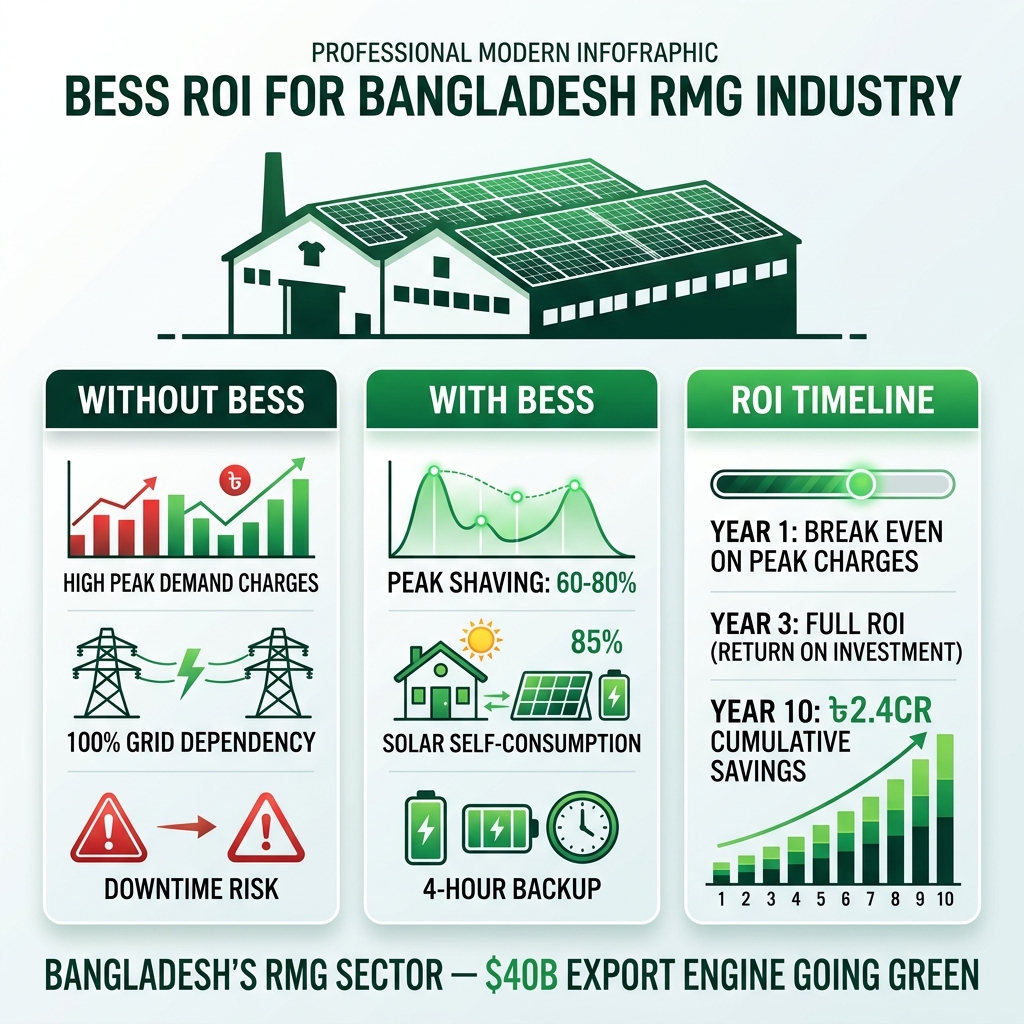
- 500kW peak factory: BDT 2–3 lakh/month in demand charges
- BESS peak shaving: 60–80% demand charge reduction
- Solar offsets midday base load: 30–50% kWh saving
- Combined payback: 14–22 months for most RMG facilities
- Monitoring portal shows live demand curve and savings
“We thought our electricity problem was consumption. It was actually our compressor start-up sequence causing a demand spike at 7:15 AM every day. BESS eliminated it completely.”
— Engineering Manager, Garments Factory, Narayanganj